
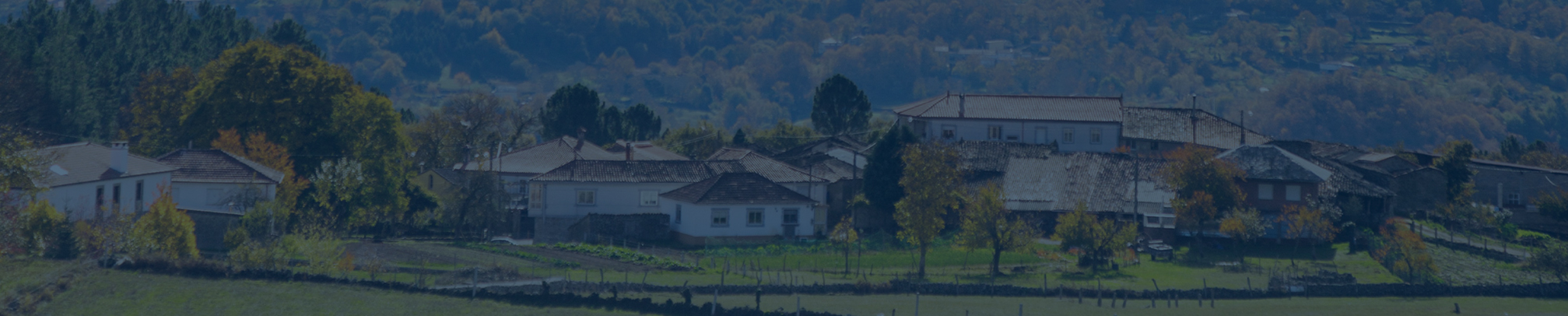
The history of Sober, a municipality in the Lemos Region in the south of the Province of Lugo, is largely defined by its strategic geographical position, notably as a crossroads leading to the neighbouring lands of the Province of Ourense. The monastic orders established along the banks of the River Sil, together with the López de Lemos family, Lords of Sober, Ferreira de Pantón, and Amarante, significantly shaped the historical trajectory of this municipality.
The fertility of Sober’s fields led its soil to be long-regarded as the best in the Lemos Region. This reputation inspired the well-known local proverb: ‘Terrón por terrón, vaite a Pantón, e se che dan a escoller, vaite a Sober’ (Clod by clod, go to Pantón, but if you have a choice, go to Sober), as recorded by authors such as Otero Pedrayo and Amor Meilán. In medieval times, this agricultural wealth made the lands of Sober highly sought after by both feudal lords and monasteries.
The Lemos Region is a well-defined territorial area in the southern part of the Province of Lugo comprising the municipalities of Sober, Pantón, Monforte de Lemos, Bóveda, Saviñao, and A Pobra de Brollón. The earliest written records of this region are primarily attributed to Pliny the Elder, a Roman naturalist and procurator of Hispania Citerior (Hither Iberia) in 73 A.D. In his Naturalis Historia, he identifies the ancient Gallaecian Celtic tribe Lemavi as being settled in this area, with their capital established at Castro Dactonium, now Monforte de Lemos. The Greek geographer Ptolemy later complemented and confirmed this information about the peoples inhabiting Galicia during the second century A.D.
Sober, along with other parts of the region situated on the banks of the Cabe and Sil rivers attracted the first hunter-gatherer tribes to settled in Galicia. Neolithic remains left by these early inhabitants can be found across the villages of Bolmente, Anllo, Brosmos, Doade, Figueiroá, Pinol, and Proendos.
In these locations, the remains of mámoas are still visible. Mámoas are burial structures from the Megalithic era, consisting of a dolmen covered by a circular earthen mound typically reaching heights of approximately five metres.
Sober’s prehistoric heritage also includes rock engravings or petroglyphs, terms used for the numerous open-air carvings found throughout Galicia. While these works feature a varied typology, the most defining characteristic of Galician rock art is the circular patterns. According to researchers Peña Santos and Vázquez Varela, these combinations display a complex range of designs that give the art its distinct identity.
Sober preserves a significant number of petroglyphs, most of which are located in Proendos, as well as in the parishes of Figueiroá and Millán. All these rock engravings belong to the circular pattern’s typology. While their exact meaning remains unclear, they are often attributed a magical-religious symbolism. Chronologically, this artistic expression dates back to the Bronze Age, between 1800 and 1700 B.C.

