- PARISHES -

Amandi is renowned not only for its vineyards but also for lending its name to the wine designation of origin covering eight parishes in the southeast of the municipality.

Furthermore, this parish is the seat of the archpriesthood, and it is prominent for its historical significance as one of the sixty jurisdictions of the ancient Kingdom of Galicia.

According to a document dating back to 842, the Monastery of Santa María de Amandi stood on this site, near the river, until its destruction by Ishmaelites raids. The current church is built upon those original foundations.

This parish is of remarkable scenic beauty, overlooking the banks of the Sil and Cabe rivers and marking their confluence at the place where these two rivers meet known as A Barca.

Another highlight of the local landscape is the Portizó stream, which historically powered numerous watermills and, until recently, some of them remained in use by the parish residents.

Local tradition holds that once it was a priory at Portizó, today, only a house remains bearing an inscription from 1669.

This parish is the birthplace of the renowned late-18th-century painter Juan Bernardo Pérez de Castinande whose works can still be seen in several manor houses in the municipality, including the Rectoral de Anllo.

San Martiño de Anllo boast a territory that overlooks the Sil Canyon. In the village of Xabrega, the Lugo Provincial Council built a dock which, along with those at Ponte do Sil and Abeleda, serves the catamarans and boats navigating the canyon along the River Sil’s calm waters.

This parish as Santo Estevo de Anllo, was home to numerous watermills, powered by the Camilo stream, also known as Xabrega and Riachuelo de los Molinos. Several of these buildings can still be restored.

Additionally, in the villages of Fervenza and Naz, various manor houses bear witness to their noble past; in fact, Naz once served as the seat of the municipal authorities.

This parish is home to Sober town centre. It is predominantly of recent construction and serves as its commercial and administrative hub. Most essential services are concentrated here, including the town hall, medical and community centres, school and a variety of local businesses from banks and pharmacies to traditional, bakeries and restaurants, among others.

In his book Descripción del término municipal de Sober, Enrique Fernández Llano mentions that the parish once held a manorial house with a heraldic coat of arms featuring a lion set upon an irregular field. Due to its proximity to the Palace-Fortress of the López de Lemos, Lords of Pantón and Sober, the parish’s history has been closely tied to that noble family.

The 1905 Geographical‑Historical Monograph of Galicia records that this parish has twelve mineral-rich springs. Part of the parish is bordered by the River Sil, whose banks were once home to numerous albarizas, which were circular or oval stone structures built to protect beehives from wild animals, primarily bears.

In the early 1940s, amid the Second World War, Barantes hosted a military detachment in the schoolhouse.

According to the historian Germán Vázquez, the 17th-century master sculptor Gregorio Blanco was born in this parish. Blanco was commissioned by the Bernardine nuns of Ferreira de Pantón to build the altarpiece for their convent’s main chapel.

This parish is home to two of the municipality’s ten viewpoints overlooking the Sil Canyon. Its Romanesque church was completely rebuilt in the 18th-century.

Bolmente has very fertile soil, which encouraged significant agricultural and livestock development. This is reflected in the large concentration of hórreos (traditional granaries) found across the parish, particularly in the hamlet of O Piñeiro. Historically, silk production also played an important role here.

Bolmente has long been, and remains, a land of ‘augardenteiros’, the artisans who distil orujo, a spirit made from the grape pomace (the solid remains left over after grapes have been pressed and fermented for winemaking).

This parish also has one of the largest expanses of communal woodland, with a total of 220 hectares dedicated to Maritime pine (pinus pinaster). By contrast, only a few traces of the old chestnut groves remain.

This parish lies to the east of the municipality, on a flat area and surrounded by the parishes of Doade, Bulso y Gundivós. It was once a zone of watermills, sheltered by the Sante stream.

The people of Santa Cruz deserve special recognition for keeping the local music band alive, with Sergio Rodríguez playing a key role in this endeavour.

Bulso has always been a predominantly farming parish. Its clay deposits have long been sought after by the potters of Gundivós, who extract the clay and use it as raw material, combining it with the clay brought from Figueroá, to form the base of their crafts.

In the 1940 Spanish Gazetteer, of Cities, Villages, Places, Hamlets and Other Entities, Bulso is listed as the site of a former tower-fortress. Although no trace of it remains today, there is a house known as Casa da Torre.

Canaval is located on the left bank of the River Cabe. Historically, it was the most industrial parish in the municipality, partly due to its railway station and the abundance of mires that supplied raw material to the three potteries once active here. The last of these closed at Christmas 1994.

Today, the few remaining businesses are family-owned. Nevertheless, after the municipal capital, Canaval continues to be the parish with most services. It is also the best connected, with access to the N-120 and a train station that underwent extensive renovation between 2023-2024. Until the construction of the municipal swimming pools, it was home to Sober’s only riverside beach.

The parish church was linked to the monastery of San Pedro de Valverde in the 12th-century, later passing to the Knight Templar and subsequently to the House of Lemos. The rectangular building with a sacristy attached to its north face was restored in the 18th-century. Some Romanesque elements from the original church remain, both inside and on the main façade.

A Roman military camp once stood near the village of Camporrairo, controlling the entrance to the Lemos Valley.

Doade is a primarily wine-producing parish and forms part of the Amandi sub-zone. It is the largest and the most easterly parish in the municipality of Sober, and although is the furthest from the town centre, it is very well connected to it. The LU-601 road crosses this municipality, linking Monforte with Castro Caldelas.

In Roman times, the Via Nova passed through this area, connecting Braga with Astorga, as the historian Germán Vázquez recounts: “among the secondary routes, there was one running from Castro Caldelas to Praesidium, a centre on the great strategic road artery or Via Nova from Braga to Astorga, heading towards Monforte, after crossing the River Sil at the Barca de Paradela.” This bridge, now submerged beneath the waters of the Santo Estevo reservoir, was already recorded in the writings of Pliny and Ptolemy regarding Gallaecia. Finally, it should be noted that sections of this Roman road are still preserved today.

The presence of Celtic settlements in this parish is attested by numerous hillforts, knolls and burial mounds.

The parish also preserves the building of a former priory, and it is the birthplace of the Martínez‑Anido family, long associated with Spanish political life.

Figueiroá is closely linked to the parish of Gundivós, supplying most of the clay used in the village’s pottery.

Visitors with an interest in history or archaeology can see the Cótaros petroglyphs and a medorra, a prehistoric funerary and ritual monument comparable to a burial mound.

Additionally, the watermills once powered by the Pousavedra stream remain in a good state of preservation.

This is perhaps the most renowned parish outside of Sober, a reputation earned by the artisans who have preserved its pottery tradition and continue to work it today. Visitor to Gundivós have the opportunity to see the potters’ workshops, the traditional kilns where the pieces are fired and purchase authentic examples of local craftmanship.

There is a castro (an ancient hillfort) at Seoane, though access is quite difficult and dense vegetation limits visibility.

In the small side portico on the north wing of the church, there is an ara (a Roman altar) bearing the inscription LVGBO ARQUIENB CAIVS IVLIVS HISPANVS V.S.L.M. Local tradition holds that this monolith was brought from the ruins of a chapel that once stood on the Mount of San Roque, in Viveiro, in the Province of Lugo.

Regarding the parish church, a popular local saying claims that the tolling of its bell clearly rings out “vale quien tiene” (“the person who has wealth, has worth”).

According to the author Enrique Fernández Llano, the first pinewoods in the municipality of Sober were planted in this parish.

This parish is well worth a visit, not only for its renowned Amandi wines, but also for its beautiful views of the River Sil and significant architectural heritage.

The church of Lobios is a fascinating example of rural Romanesque style with transitional and pointed-arch elements. Although, it dates from the 13th-century, the sacristy is a later addition, and the Baroque belfry was built in 1806. The materials used in its construction are regular perpend granite ashlar.

A 10th-century Visigothic monastery once stood on the site of the present church. The toponym Mosteiro survives today as the name of a hamlet within the parish.

Adjacent to the church is the Chapel of the Queen of the Angels, famous for a local legend. The story tells of a girl who stole a gold chain from a moura (Moorish woman), who instantly transformed into a serpent. The girl fled for her life, as she passed the chapel, she prayed to the Virgin and the serpent was restored to human form.

Between the church and the chapel, an impressive cruzeiro (a stone cross) stands on the right-hand side of the road that connects Sober capital with Doade.

Millán is a land of legends and traditional roscas, artisan ring-shaped sweet breads.

One of the legends recounts that Roman soldiers used to come to the spring of Fonterdá seeking healing, as the spring was famed for its medicinal properties, especially for digestive ailments. Children from the nearby village of Francos, in the parish of Proendos, were warned against wandering near the spring, as it was said to be the home of the “Sacaúntos” (a bogeyman-like figure).

The water from the Fuente del Cura (Priest’s Spring) is also reputed to be a remedy for toothache, while another local belief maintains that Saint Apollonia was hidden at the “Pena de Belán” during the Barbarian invasions.

The roscas of Millán were famous throughout the entire region. Artisans from the village would sell them directly at local festivals, feiras (markets) and romerias in the surrounding towns. Today, however, only a single rosqueiro (rosca baker) remains in the parish.

This parish lies in a valley and is crossed by the River Neiras, also known as the Fervedón. It borders the municipality of Monforte to the north and east.

Neiras is primarily dedicated to farming, livestock and forestry. An aerial ropeway once ran through this parish, as well as through Refoxo and Canaval, transporting ore from the Freixo mines to the Canaval railway station and the pylons that supported the power line remain standing today.

In the hamlet of A Devesa, there is a picturesque spot featuring a stream and an old mill building, which  has been converted into a carpentry workshop.

The village of Pinol first appears in historical records at the beginning of the 11th-century and was dependent on the monastery of Santa Cristina de Ribas de Sil until the 15th-century. Later, the parish became a benefice of the House of Lemos and the great Rodrigo de Castro served as  the parish priest while acting as procurator.

Once again, we venture into another parish that is part of the Amandi wine designation of origin, where grapes are primarily harvested in Chanteiro and A Barca de Sampil. Along the ribeira there is a notable abundance of native trees and a variety of aromatic and medicinal herbs.

Pinol is home to the Sanctuary of Our Lady the Most Holy Virgin of Cadeiras, built in the 18th-century. Every 8th September, it becomes a place of pilgrimage due to the miracles attributed to this dedication of the Virgin Mary.

As an interesting fact, the author Enrique Fernández Llano points out that the longest north-to-south distance across the Province of Lugo is between Conejera Island and the Mount of Cadeiras.

The parish church of Pinol is a Romanesque building, apparently dating from the 13th-century, with a sacristy attached to the rear left corner.

This parish lies adjacent to the parish of Arroxó and stands out as the most historically interesting within the municipality. Its terrain is largely flat, with A Peniña-Mer reaching its highest point at 492 metres above sea level, while its lowest point is Outeiro, at 432 metres.

The settlement of Proencia once stood around the parish church. Most historians consider it to be of Roman origin, although some argue that it is Suebic.

Remains of this ancient settlement continue to be found. The most archaeologically significant discoveries date from 1945; these included a tomb, a skeleton, two bells and other bronze and pottery artefacts, which are held in the Provincial Museum of Lugo.

Subsequent studies carried out in 2020 led to the discovery of the first horreum (raised granary) with parallel walls in Galicia. It belonged to an Early Roman Empire villa and consisted of a main building and various associated farming structures, the remains of which are still being excavated nearby.

There are several petroglyphs in this parish, many of which are visible, particularly those located on the O Xestal property and others near the church. The significance of these sites lies not only in their intrinsic value but also in their eastern location, far from the Province of Pontevedra, where the main concentration of rocks engravings of Galicia is found.

As for the parish church, the current building stands upon its original Romanesque structure, of which some remains are still preserved, likely dating from the second half of the 12th-century. Inside the church, there are fascinating wall paintings; these underwent restauration during the second decade of this century.

In addition to the various heraldic houses found in this parish, the manor house commissioned in 740 by Lope López de Lemos y Sober, Lord of Ferreira de Pantón and Sober, stands out. Today, the building lies in ruins, with only the exterior façades and part of the roof remaining. The family coat of arms preserved on its walls is the origin of the coat of arms of Sober Municipality.

In this parish, at the village of Sober o Vello, the municipal offices were formerly situated until their relocation to the village of Berea, now known as Sober.

Proendos was the birthplace of Enrique Fernández Llano, author of the first monograph on this municipality, entitled Descripción del Término Municipal de Sober. The book was published in 1977.

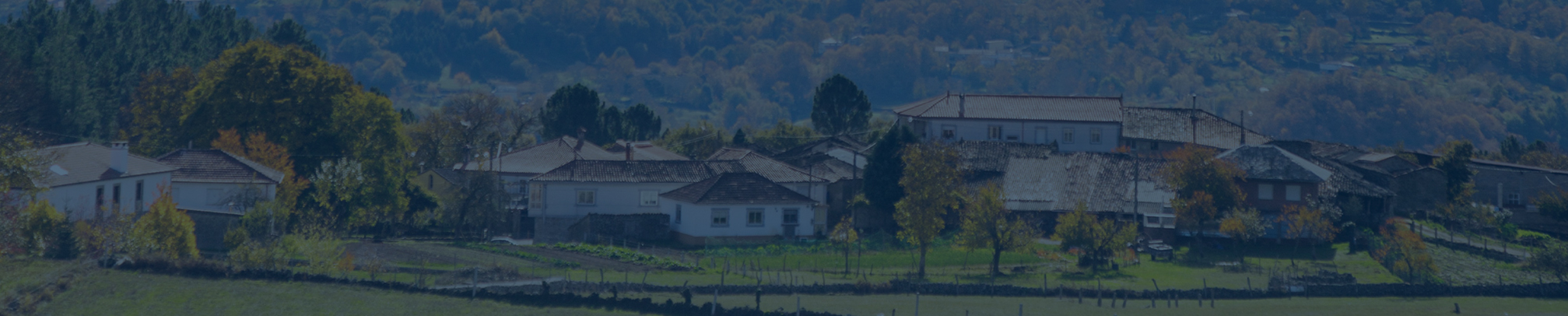
This parish is surrounded by Proendos, Arroxó, Canaval, Gundivós and Neiras. Its church is located in a place known as O Burato, an area of outstanding natural beauty.

This parish was mentioned as early as 1128 in a public document, in which King Alfonso VII and Queen Urraca I bestowed the sinecure of Santo Estevo de Refoxo upon Alonso López of Sober and Lemos. A sinecure was a position, often within the church or civil service, that provided an income but required little or no actual work from the holder.

The brothers Manuel and Victoriano Álvarez Fernández, both notable ecclesiastical figures, were natives of the village of Pousada. Manuel served for many years as chaplain and confessor to Queen Cristina, while Victoriano was a chaplain in the Royal Navy.

These brothers, particularly Manuel Álvarez, were also responsible for the construction of the road between Monforte de Lemos and Sober.

In recent years, the parish of Rosende has undergone significant development after becoming the headquarters of the Belarmino Fernández Iglesias Foundation. The foundation is based in the Casa de Ribas, a manor whose noble lineage is reflected in the coats of arms and shields displayed on the building. Since the 1997-1998 academic year, a catering and hospitality school has operated here under the foundation’s auspices.

In addition to the school, the foundation also provided sports facilities, including swimming pools and tennis courts. These were open to the public until the current municipal facilities were established, after which the foundation’s ones fell into disuse.

The church and the rectory, built in the style of a monastery or priory, are also well worth a visit. Rosende is a wine-producing area within the Ribeira Sacra Designation of origin (D.O.), specifically in the Ribera del Miño sub-zone. The parish celebrates the festivity of Saint Miguel. In recent years, the dates were moved from September to August to take advantage of better weather conditions.

Santiorxo, together with the parish of Millán, is renowned for its roscas, traditional ring-shaped sweet breads, that are still handmade today. In the hamlet of Barreiros, the remains of an old telleira, a former artisanal tile-and-brick factory.

This parish was home to the Barca de A Somoza, a wooden river crossing barge used primarily by inhabitants of several Ourense municipalities, such as Parada do Sil, Montederramo, Trigás, Maceda, Chandrexa de Queixa, Alto de Rodicio and other nearby areas, to cross the River Sil and attend the fairs and markets of the Lemos Valley.

Two sites are particularly noteworthy: the Santiorxo Viewpoint, which stands at 538 metres above sea level and offers spectacular panoramic views of the River Sil Canyon, and the O Noguedo manor house, which features distinctive springs in its inner courtyard.

Vilaescura is bordered by the River Cabe, which enters the municipality at Canaval and flows through these two parishes, as well as Rosende and Santo Estevo de Anllo, where it meets the River Sil.

In the village of Vilaescura, there is a castro, (hillfort) located on a private property at the point where the slope breaks and the River Cabe canyon begins.

However, it should be noted that a large proportion of the stone structures of this hillfort has been dismantled over time.

Both the archaeological site and its surroundings lie beneath a pleasant oak woodland. This makes for an enjoyable walk from the parish church, offering views over the River Cabe in an area of outstanding natural beauty.

close-link
close-link